
An Ice Age is a period when Earth’s temperatures are significantly lower. During such times, large parts of the planet are covered by extensive ice sheets and glaciers.
The most recent Ice Age lasted from about 2.6 million years ago to 11,700 years ago. It was primarily triggered by shifts in Earth’s orbit. These shifts changed the amount of solar radiation reaching Earth’s surface. However, orbital changes were not the only cause.
Several factors worked together to create long-term cooling cycles. These included low atmospheric CO₂ levels, ocean circulation patterns, continental positions, and volcanic activity.
Shorter summers prevented ice from melting completely. As a result, ice sheets grew thicker over time. This growth reinforced a powerful cooling feedback loop.
Why Ice Age Fears Are Reappearing in a Warming World
Why are climate scientists increasingly concerned about something called the collapse of the Atlantic Meridional Overturning Circulation (AMOC)—a process that could potentially trigger Ice Age–like conditions?
So, let’s first understand what is AMOC (The Atlantic Meridional Overturning Circulation).
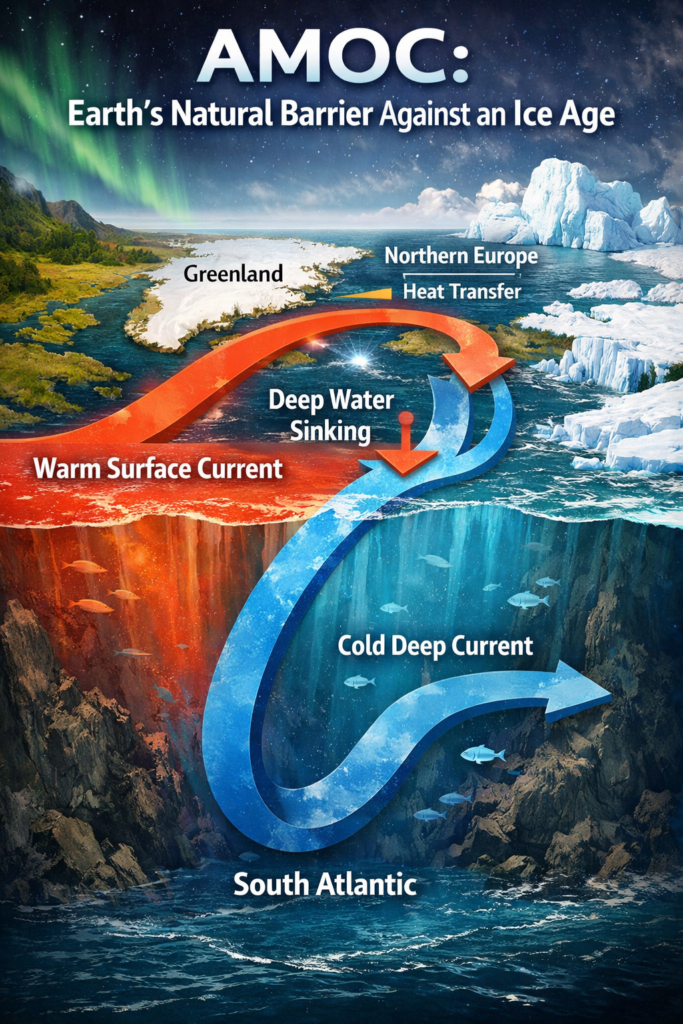
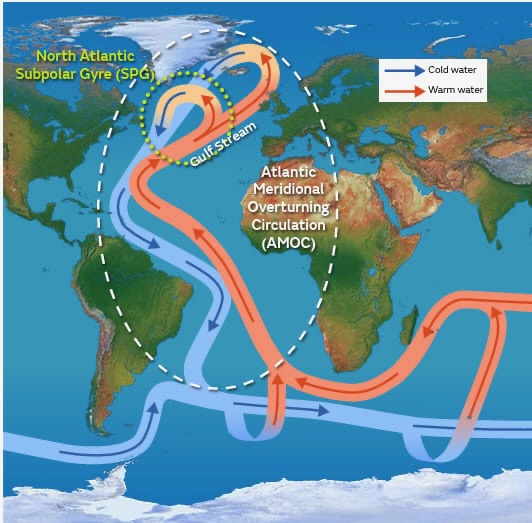
The Atlantic Meridional Overturning Circulation (AMOC) is a major ocean circulation system that transports warm, salty water from the tropics to northern region. As this water reaches higher latitudes, it cools off, becomes denser, sinks, and flows back southward as a deep ocean current. This process plays a critical role in distributing heat around the planet, regulating global climate, and keeping much of Europe relatively warm by preventing extreme drops in temperature.
In this blog, we’ll examine Iceland’s warning about the potential collapse of AMOC(Atlantic Meridional Overturning Circulation) and why such a collapse represents an existential risk and a national security concern for this country.
To understand the severity of these potential impacts, we must first explore the underlying mechanisms driving them.
We’ll begin by explaining what AMOC(Atlantic Meridional Overturning Circulation) is, why it is so crucial to the climate system, and how its failure could escalate into a serious national security threat.
AMOC(Atlantic Meridional Overturning Circulation) A Nature’s Ice-Age Shield
The Atlantic Meridional Overturning Circulation (AMOC) is a large-scale system of ocean currents. It transports warm surface waters northward and returns cold, dense water southward at depth within the Atlantic Ocean. This circulation plays a critical role in maintaining oceanic ecosystems. It regulates temperature, redistributes heat, and transports nutrients that sustain marine food webs and biodiversity.
How AMOC Works, Step by Step
1) It starts when warm surface water moves toward the poles, such as the Gulf Stream in the North Atlantic.
2) When water reaches in polar regions, colder conditions cause this warm water to cool, leading to the formation of sea ice.
3) As sea ice forms, salt is left behind in the surrounding seawater, making it saltier and denser.
4) This dense, salty water sinks to the deep ocean and flows southward.
5) Eventually, the cold deep water rises back toward the surface, warms up, and the cycle continues.
Because of this continuous movement, AMOC is often described as a global conveyor belt, driven by differences in temperature and salinity. A crucial feature of this system is that the entire circulation operates very slowly, unfolding over decades to centuries.
The Current That Keeps the Climate in Check
The AMOC is often called a “climate regulator” because it helps prevent extreme freezing in the Northern Hemisphere. By transporting heat northward, it keeps Europe significantly warmer than other regions at similar latitudes, such as Greenland.
This system also influences global weather patterns, including the strength of monsoons in India and West Africa, as well as rainfall patterns in the Amazon basin.
In addition, the AMOC plays a pivotal role in nutrient transport, bringing nutrient-rich deep ocean waters to the surface, which supports the growth and development of marine life.
Finally, the AMOC acts as a major carbon sink by absorbing atmospheric carbon dioxide and storing it in the deep ocean, helping to regulate CO₂ concentrations in the atmosphere.
Why AMOC(Atlantic Meridional Overturning Circulation) Slowdown Is a Climate Tipping Point
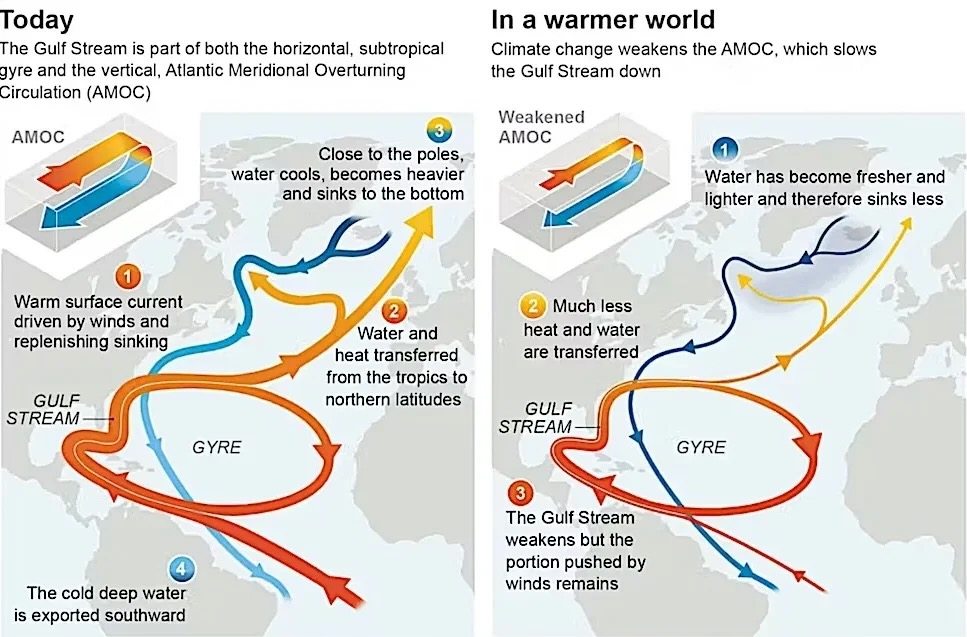
The AMOC is inherently a slow-moving system, and any external factors that further slow this mechanism are a serious cause for concern. Because AMOC plays a crucial role in maintaining the balance of temperature and salinity in the oceans, its failure represents a climate tipping point.
The key reasons why a slowdown of AMOC is concerning include:
1) Rising global temperatures are causing accelerated melting of glaciers and ice sheets, especially in Greenland. This adds large amounts of freshwater to the North Atlantic, making surface waters less dense and disrupting the sinking process.
2) Reduced sinking of dense water weakens the southward flow of deep ocean currents, which in turn can alter weather systems, including monsoon patterns in southern regions.
3) Weaker northward transport of warm water would lead to much colder winters in Europe, potentially pushing northern regions toward Ice Age–like conditions, accompanied by more severe storms.
Why Iceland Is Treating AMOC as a National Security Risk
In October 2024, a group of climate scientists wrote an open letter to the Nordic Council of Ministers, warning about a potential collapse of the AMOC and the growing risk of irreversible climate changes associated with it.
https://en.vedur.is/media/ads_in_header/AMOC-letter_Final.pdf
The warning is based on a study by the Potsdam Institute for Climate Impact Research in Germany (August 2025) and findings presented at the 2025 Arctic Circle Assembly in Reykjavík. Scientists cautioned that the tipping point for an AMOC collapse could be crossed within the next 10 to 20 years.
Taking these warnings seriously, Iceland became the first country in late October–early November 2025 to declare changing climatic conditions a national security threat.
As Iceland’s Climate Minister Jóhann Páll Jóhannsson stated in an email:
“It is a direct threat to our national resilience and security.”
This marked the first time a specific climate-related phenomenon was formally identified as a potential existential threat by a nation.
In response, various ministries in Iceland are preparing for risks associated with a potential AMOC collapse. At the same time, the government is assessing what additional research, preparedness measures, and policy actions it must implement to address future climate-driven disasters.
After the Ice-Age Barrier Fails
We have discussed the AMOC and its effects, but the story does not end there. A collapse of the AMOC does not simply mean the onset of an Ice Age; it would trigger widespread and potentially irreversible changes in global atmospheric and climate systems.
Cooling in the North Atlantic would be only the tip of the iceberg. An AMOC collapse would reorganize the global climate system, producing localized Ice Age–like conditions in some regions while global temperatures continue to rise.
The Global Consequences of AMOC Collapse
1) Accelerated melting of Greenland’s ice sheets would initially increase the freshwater entering the North Atlantic.
2) This excess freshwater would reduce the density of surface waters. As a result, the sinking of saline water would weaken, disrupting the southward flow of deep ocean currents.
3) Northern Europe and the North Atlantic, including regions like Iceland, would experience extremely cold winters and harsher storms. Expanding sea ice and shorter growing seasons would follow.
4) Shorter growing seasons would increase the risk of food shortages, while colder conditions would place greater pressure on energy production. Expanding sea ice would also restrict marine transportation.
5) Climate impacts would extend further by disrupting global rainfall patterns, shifting monsoons, drying parts of Europe, and causing heavier precipitation in other regions.
6) Along the eastern coast of North America, weakened circulation could lead to rising sea levels and increased flood risks.
7) Reduced nutrient transport would weaken marine ecosystems, while a decline in carbon sequestration would increase atmospheric carbon dioxide levels.
8) Higher atmospheric CO₂ concentrations would further amplify global warming, reinforcing a dangerous feedback loop.
The most alarming aspect of a failing AMOC is the speed and irreversibility of its collapse. While a healthy AMOC operates slowly over decades and centuries, its breakdown could occur rapidly, producing abrupt and severe climate consequences.
Is AMOC Collapse Reversible—or Is It Too Late?
When discussing such a critical phenomenon, giving a straightforward answer can be unsettling. This is because an AMOC collapse is no longer considered a rare or distant possibility.
Scientists at the Potsdam Institute for Climate Impact Research in Germany have been closely monitoring changes in the AMOC for many years. In 2021, they reported one of their most alarming findings. The data revealed early warning signs that the system may be approaching a climate tipping point.
According to their calculations, there are uncertainties. However, the findings suggest that the AMOC could potentially shut down completely within the next 10 to 20 years if current trends continue.
One crucial point stands out. While reversing an AMOC collapse may not be possible once it occurs, delaying it is still within reach. A rapid and significant reduction in fossil fuel use could slow global warming and reduce stress on the AMOC. This could help extend the system’s stability by several years. If we act quickly to cut emissions, there is still a narrow window of hope.
When we plan to slow global warming we need fast growing trees which can absorb CO2
Read More About –
https://ecosciencezone.com/co%e2%82%82-absorbing-trees-for-rapid-reforestation-and-carbon-capture/
This is why understanding the AMOC is not merely a climate issue but a long-term risk management challenge for humanity. Its collapse would not only disrupt climate systems but could fundamentally reshape how and where humans live on this planet.
Cold Born of Disruption, Not Nature
Climate tipping points do not announce themselves with certainty; instead, they warn us repeatedly, signaling the risk of approaching disaster. The potential collapse of the AMOC is one such wake-up call. It reminds us how close we may be to profound and irreversible change.
Delicate systems maintain Earth’s stability, but they can be disrupted. This also means that we do not predetermine the future. Through genuine and timely efforts to protect these balances, we can slow down dangerous changes. This can help ensure a stable climate and healthy ecosystems for future generations.
Leave a Reply